Pages

Saturday, October 27, 2012

Partying in Palestine!


We are thankful for having the volunteer Heather Garlick with us for three weeks, helping with the urgently needed fund raising and documenting. Thank you Heather!

The children of the Bugs of the Future kindergarten are having a party! It is the last day before they finish school for the Eid celebrations and the Sounds of Palestine (SoP) team have been asked along to get festivities underway. The event coincides with my first day helping out the MwB and SoP projects – right in at the deep end…

We arrive at the school in Aida camp, Bethlehem to be confronted with the sense of organised chaos which typifies large groups of small children the world over. The kids are proudly and perfectly turned out in a rather stylish pastel pink and brown colour combination. The girls have a range of pink accessories, from stripey tights to flowery hairbands, complimenting their uniforms. As we stand talking to the kindergarten teachers I glance up to see a sea of brown and green eyes gazing at me with anticipation from the nearest classroom. It seems everyone looks forward to a visit from Sounds of Palestine!

We are in the school for a little over an hour and a half and teach three very excitable classes. The kids are remarkably well behaved and completely enthralled by the guitar and the singing. We sing songs in Arabic, many of which have associated activity and movement. Since my knowledge of Arabic is limited to a badly pronounced hello I am at a loss to know what is going on. However, it is not difficult to see that lots of funny faces and arm waving is required which is extremely entertaining for all involved.

But the music classes at Bugs of the Future are not just for fun. For her visits twice a week Fabienne, one of the music teachers, creates detailed lesson plans, designed to help the children grasp concepts such as short and long as well as to aide interaction. More than that, the music helps to relieve stress in a classroom where many of the children have gone through emotional trauma a grown adult could not handle. Indeed, pink uniform aside, this is not a picture which should be seen through rose tinted lenses. Many of the children in this classroom have seen parents or family members injured or imprisoned. Inevitably, these issues are brought to the playground. In our first session one little girl enters the classroom in tears, not the wails of a disgruntled toddler but the whimpers of a person suffering intense emotional distress. In amongst the cheeky and mischievous kids there are children who are quiet and withdrawn, too scared to take part in the lesson.

Music helps in these situations and the Sounds of Palestine project has seen impressive results. On the way home Fabienne tells me of one child who stopped bedwetting during the nights after the music lessons. A girl had never spoken a word in kindergarten and surprised the teachers when she suddenly said the first line of the welcome song Fabienne sings every week with the children. To assist this process we are also joined by Magedah, a social worker, who was trained within the MwB/HLT Workshop Leadership Training. She is able to watch the children closely to note erratic behaviour and even take individual children out of the class for special support. However, as with many things in Palestine, the Sounds of Palestine project is over-subscribed and under-funded. There is simply no money in Palestine. The Musicians without Borders project is able to train groups of Palestinians to run community groups just like these but there is not enough funding for the community groups themselves which would extend the reach of the healing quality of the music.

But today was primarily about fun, and fun was most certainly had. What did I learn on my first day with Musicians without Borders? These may be children facing huge problems both in the present and in the future but they’re also just children, bright eyed, bushy tailed, naughty, funny, silly children. They deserve all the opportunities that life can provide, opportunities Sounds of Palestine, Musicians without Borders and Holy Land Trust are striving to deliver.

All pictures are taken by Heather Garlick.
Sounds of Palestine could not have taken place without the support of Katherina Werk, Romisch-Katholische Landeskirche des Kantons Luzern and Romisch-Katholische Kirche des Kantons Basel-Stadt.

Wednesday, September 5, 2012

Music Intervention

During a hot summer day in July, we had the honor of having a special guest: Shoshana Gottesman, "a musician activist who devotes her time to the development of music intervention techniques with conflict transformation, youth empowerment, and music education."

She wrote the following article on her blog, Music Intervention, about her visit to Musicians without Borders' project, the Music Bus:


Thank you Shoshana!

Monday, August 13, 2012

How To Build A Studio (and a better world)

Almost three months ago Joel went back to San Francisco. He had volunteered for four months with Holy Land Trust and we couldn't have wished for a better person to help us building a recording studio. Joel helped the young rappers to create, design, and build the studio. He trained them in recording, mixing, and making beats. Joel expressed his wish many times: volunteering in a project that will continue to grow after he leaves Bethlehem.

Dear Joel, I think your wish came true! Since you left, children and youth from al-Fawwar refugee camp, SOS Children's Village Bethlehem, Dheisheh refugee camp, Beit Ummar, Hebron, Bethlehem, and Silwan have been recording their songs in the studio. Musicians with different musical backgrounds met in the studio and explored new ways of making music together, and children with cancer recorded their wishes.

Thank you so much Joel for all your help and support, we all hope to see you very soon!

Meet the rappers and see how the studio was created in the video made by Joel:

How To Build A Studio (and a better world) from Stories From The Checkpoint on Vimeo.


The studio was created with the generous support of the Netherlands Representative Office in Ramallah.

Wednesday, August 1, 2012

Small and Big Wishes


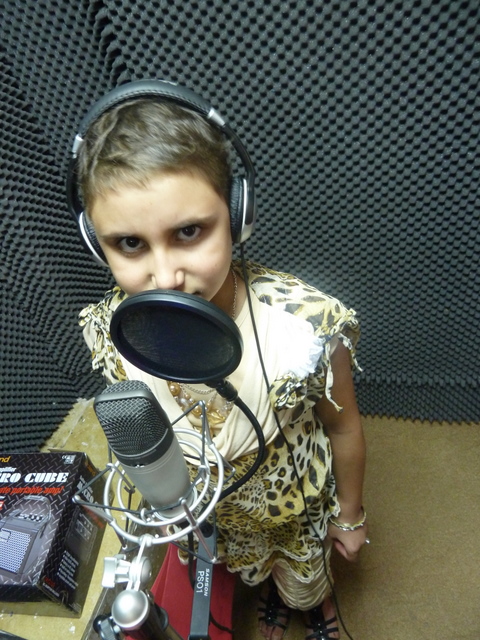
Today six children with cancer from Bethlehem and Hebron recorded a CD together. They sang a song about wishes, and recited many wishes written by children from all over Palestine that suffer from cancer. This day could only succeed because of the wonderful cooperation between all involved: Basma Society arranged the children, Holy Land Trust and Musicians without Borders trained the soundman, their trainees wrote the song, and they arranged volunteers together with Basma Society, Ra'afat from Jerusalem played the instruments, and the Netherlands Representative Office in Ramallah has supported the establishment of the studio Palestine Street. A special thanks goes to Fadi "doctor clown" and Muhanned who coached the children and Hisham who recorded the song. 


But this day could never have taken place without these amazing children, who all came to the studio even while the trip was long for some of them, the weather very hot, and the recording challenging during Ramadan (most of the children are fasting, so no drinking or eating). One of the children, eight years old, had chemotherapy only two days ago, and it was obvious that she wasn't feeling well. But she wanted to continue and sang and recited the wishes with a lot of passion. The parents that came were of great support for the children: they sang together with their children and applauded every child that finished recording his or her voice.

When the CD is finished, we will give it to the children in the hospital and anyone else that is interested in hearing the wishes of these children!


Free translation of the text of the song from Arabic to English:

a small wish, a big wish
what do you wish children
the most beautiful wishes

in Basma Society, the children are playing
and today our wishes will come true
the most beautiful Basma Society
our most beautiful wishes

Thursday, July 19, 2012

Music with deaf, talented children

Yesterday night I tried to arrange a bus to bring 16 deaf children and their supervisors from Hebron to Bethlehem. I called my friend from a village nearby Hebron, and he asked me why I wanted to spend money on bringing the kids all the way to Bethlehem in this heatwave. Why didn't we, the music workshop leaders, travel to Hebron to give the workshop there? Although our initial plan was to arrange a trip for the kids I started to doubt if it was a good idea to let the children come during one of the hottest days of the summer. But as soon as I arrived, I knew we had made the right choice! Somehow the hall in the new building of HLT was filled with a very positive energy, and for two hours every single person in the hall seemed to radiate with happiness and love. Except for the bus driver maybe, since he spent most of the time sleeping in a corner.

Halimeh explains in sign language to the children what we will do today in the music workshop. Halimeh is deaf herself and followed the HLT/MwB training to become a music workshop leader. Her sister Magedah translated the full training into sign language. For the children,  Halimeh and two of her deaf sisters were great role models. They showed the kids that being deaf doesn't have to be an obstacle to become anything you want in life!

When we did movements and rhythms, I had to review my preconceptions towards deaf children: these kids  played rhythms together as if they had followed music training for weeks!

Every child showed us his or her name, which was repeated by the whole group. Deaf people  have often two names: a name spelled with letters, and a name made by a movement that is different for every person. 

Magedah, a professional sign language translator and also trained by HLT/MwB, explained the "fruit game" in sign language. Her movements were translated by the teacher of the children, because most of these children don't know the official Palestinian sign language. Instead they know a specific 'dialect', a sign language developed in their school in Hebron, a city south of Bethlehem. Magedah showed the kids the official signs for apple, orange, banana, and grapes, so we would understand each other during the "fruit game".

Halimeh shows every child which fruit he or she is. Here she is showing little Mohammad that he will be an orange.

The leader in the game showed the children that all the oranges had to change places! Little Mohammad is running to catch a free chair, but he won't be fast enough....

Mohammad didn't make it to a free chair, so now it is his turn to be the leader and call for a fruit. He is making the orange movement in this picture...

But again he didn't make it to a free chair! This time he tries it with  the  sign for banana.

After Mohammad managed to get a chair, another girl became the leader.

Although I was doubting to use the sticks in this workshop, Halimeh convinced me to use them. She told me she had really enjoyed playing the sticks during the training and was sure that the kids would like it as well. She was right! I was so impressed by their concentration, their capability to play together, to play soft and loud, slow and fast, and to combine different movements.

Some of the children were shy at the beginning of the workshop, but soon the ice broke and no one was embarrassed to make silly movements. 

In this variation, where one stick is hit by the other, children often have problems holding the stick from the top and instead hold the sticks at the bottom. But not this group! They all managed to play the rhythm with one hand while holding the stick from up with the other hand.

One by one the children took turn in being the leader, showing the rest of the group which movements and rhythms to make. 

During this exercise, it became clear that the children didn't get the chance often to show their creativity. Many of them copied the others and were not motivated to make a new movement. But even when they would do the same movements over and over again, they would still have a big proud smile on their face when it was their turn to be the leader.

During the second half of the workshop, Fadi, also trained by HLT/MwB joined  the group. I had not planned to do anything with recorded music, but Fadi had a different approach...he did the 'water drop dance' as if the kids could hear all the music. And to tell the truth...it really looked as if they did!

The bus driver in the meantime became very tired and fell asleep in the back of the room. Although I had put the music quite loud he didn't have a problem to sleep through it.

Who said that deaf children don't like to dance?

While the bus driver was still sleeping, the children could release their energies on the parachute, donated by our dear friend from England. Thank you so much!

The ball in the middle was supposed to stay on the parachute, but soon the game changed into smashing the ball anywhere except of inside the parachute!

During the last dance, the children invented movements, followed by three claps, which was the sign for the next child to create a movement for the group. I'm still not sure how they managed to clap together and to understand the structure of the dance so fast.

A final picture was taken in front of the beautiful new HLT building in the center of Bethlehem. Thank you Magedah, Halimeh, Nadiah, Amineh, Fadi, the caretakers from Hebron, and of course the talented children!
Thank you Prelude Foundation for the transportation and Kareema for the pictures!

Sunday, July 8, 2012

Can I Stay in the Hospital?


"I want to go home..."

When Fadi from Aida refugee camp entered the hospital room of a 12-year old girl with cancer, he found her crying because she wanted to go home. As a volunteer for Basma Society, Fadi often visits children with cancer in a simple hospital. Equipped with a red plastic nose and a funny doctors outfit, Fadi sings, makes jokes, and gives the children and their mothers a break from their harsh reality.

Fadi brought a guitar and let the girl play on the guitar. Together they created music and a friendship. When they finished playing, the girl asked Fadi if he could come the next day again. Fadi told her he wasn't free, but he could come the day after. "Mama, I hope I will still be in the hospital after tomorrow so we can make music again!"

The following pictures were taken today, when we visited the hospital together with volunteers from the Basma society to play music with other children. We were happy to hear that the girl from the story went home again!


Doctor Clown Fadi thank you for all your beautiful and important work with these children!

Sunday, June 24, 2012

John Cena in Ramallah


Today, the 24th of June, we went to Ramallah to give music workshops for 54 children in a summer camp. We were invited by the sister-in-law of Sireen, a music workshop leader from Dheisheh refugee camp. Sireen was joined by Amira from al-Azzeh refugee camp and MwB music coach Fabienne.

Amira:
"When we first arrived there we saw that the children were so excited that they are going to play and learn new songs. And actually I was also very happy to give a workshop again because I hadn't done any workshop for more than one month."

Amira singing with the girls


We worked with two different age groups: 4-7 years old and 8-13 years old, boys and girls mixed.

Fabienne:
"I started with the oldest children, and just before I went outside to the workshop space, one of the youth leaders told me that some of the kids could be annoying. I asked her what she meant exactly, and she explained to me that especially the older kids could complain sometimes that they didnt like an activity because it was childish or not interesting to them. When we formed a circle, I observed how the boys and girls refused to mix, and I was afraid that the boys wouldn't enjoy the workshop because it would be too 'girlish'. We started with a warming up of body percussion, followed by rhythmical breaks. I gave the group the first break, but for the second break I asked the boys to come up with something. They tried out some movements and then decided to do the "John Cena" move. I had seen the red and purple John Cena children t-shirts everywhere in Palestine but today I also learned the John Cena move: while waving their hands in front of their face with spread fingers, the boys shouted: You Can See Me, You Can See Me! The girls decided on a clapping rhythm to accompany this call. And that is how the group invented their own break, a break I could never have thought of!"

John Cena...
The boys showing us the "John Cena move"
In the mean time, Sireen and Amira were working with the younger group inside the building.

Sireen:
"We did different dances with the children like "1-2-3", "drum dance", and "Khashaboo" (khashab means "wood" in Arabic). The children were the most excited when we did Khashaboo and loved the story I told them to introduce the dance:

One day, Amira, Fabienne, and I gave a workshop in a small village next to Ramallah. We were very surprised to see a strange boy in the group, and I asked him from where he was. Actually he looked like a wooden doll! He told us that his father, a carpenter, had made him with a saw! 

Kids dancing the Khashaboo dance

Another thing I liked, happened when we did the drum dance: when I was supposed to show the group a new drumming movement, I forgot it and didn't make any movement. Then a four-year old boy saved me by drumming with his hand on his lower back! We copied him and I had learned a new movement from this little boy!"

Making movements with Sireen


Thank you Ruweida for making the pictures!