Pages

Thursday, March 15, 2012

How the Rabbit Found a Home


My mother is dead.”

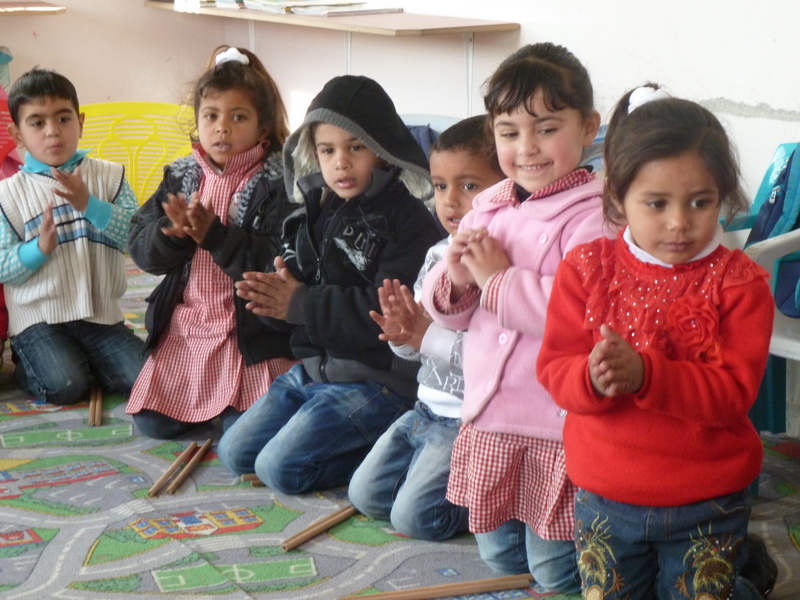
We just sang a song about a poor man without a house that sold his pants to buy macaroni, when a little boy told one of the workshop leaders this sad news. It was during the second workshop in the kindergarten in al-Azzeh refugee camp, Bethlehem. A group of 35 children, age 3-5, gather every day in the small space. Some of them have behavior problems, some have special needs and can barely talk, some show very violent behavior, and one girl never smiles. But it would be very superficial to stick to this observation. Because when we had a closer look, we saw that the boy that doesn't talk, is an amazing dancer; the boy that fights constantly, is a talented painter; and the girl that doesn't smile, sings beautifully.


Maysa told a story about a little rabbit that didn't have a home, like the poor man from the macaroni song. The rabbit met many animals in the story, and every animal made a different sound, explored by the children. When the rabbit meets the lion, who offers the rabbit to stay at his home, the rabbit is afraid the lion will eat him.

I'm afraid at home, because many times I'm alone and my older nephew is making me very scared!”

What was supposed to be a workshop, turned out to be an opportunity for this little boy to share his worries, living without a mother and being scared at home. But unfortunately we couldn't change his home situation so instead we did what we could do: we danced and sang and tried to show the children how imagination can bring us to the most fun and peaceful places.

At the end of the story the rabbit without a home found a sweet rabbit girl with a beautiful house where they could live together and be happy forever...


After singing a song about a carpenter, the children drew carpenters,
 hammers, screws,  saws, and drilling machines...


Thank you workshop leaders Sereen, Amira, and Maysa, we will continue to dance next Sunday!


Sunday, March 4, 2012

2nd Music Workshop Leader Training week

During the last week of February, MwB-trainers Otto and Marijke traveled again to Bethlehem for a training week. About 20 social workers, divided into two groups, participated and learned new musical skills that they can use during their daily work.


MwB trainer Otto shares movements to accompany the song "Elena"

The last training day was dedicated to the presentation of miniature workshops executed by the trainees. A lot of creativity and didactic and pedagogical skills were portrayed during these workshops: Zahra from Aida refugee camp enchanted us all with her imaginary bird that went from hand to hand before it was freed into the sky.

Zahra started her workshop with a name game in which all participants
were connected with each other trough a red string. At the end of the workshop,
we were connected once again by sharing the imaginary bird with each other.

Maysa from al-Azzeh refugee camp made everyone laugh with her version of "Layla al-Hamra", the Arabic Little Red Riding Hood. Some participants were concerned that young children might be afraid of the wolf (in Maysa's version a tiger), what led to an interesting discussion about protecting young children from anything scary or exposing them to scary stories to prepare them to real life, which is also not always about red capes, picnics and beautiful forests.

The workshop of Maysa and Lotus designed for kindergarten children
started with a name game in the shape of a train
Little Red Riding Hood and the Tiger

After the story of Maysa, Lotus from Hebron does an activity with balloons,
teaching the participants about the color "red"

Halima taught us how to say apple, cat, lion, zoo, and many other words in sign language by using a funny ABC-video and by creating a dance that expressed all different words in sign language. Thanks to the translation by her sister Majda and her precise observation of the trainers, Halima is able to follow the music leadership training without hearing a single word.

As an introduction to his workshop, Rasheed from Beit Ummar explained to us why he would sing and make movements with the song during his workshop. He showed us the following drawing, and explained that the upper part is our brain, and the lower part our emotional world, our feelings.

The drawing of Rasheed

The lower part is under water and not visible for others, unless we express our feelings. The border between the brain and feelings is open and there is a connection, as well as between the brain and the surrounding space (our environment) and the feelings and the surrounding space. But if we work too hard, sometimes the border between our feelings and surrounding space can be shut, and if we really work too hard the border between the brain and feelings also closes, what can lead to serious problems. To relax and de-stress and (re-)open these borders, he suggested we would sing and move together, so we could continue our day afterward fresh and relaxed.

MwB trainer Marijke explains different goals of a music workshop,
which includes musical and social goals

Another creative idea came from Rasheed: he was asked to mediate in a school were there was a big fight between teachers. The situation had reached a point that some of the teachers even refused to talk with each other. Rasheed planned to use one of the dances that Marijke had done during the training, in which participants shake each other's hands and change partners many times in order to shake everyone's hands. He expressed his hope that the funny music accompanying this simple dance would release the tense atmosphere and bring the teachers closer to each other again.

Starting next week, all trainees will receive six Nonviolence workshops organized by Holy Land Trust and they will continue using their new skills in their daily work. For the next weeks, workshops will be given to youth in an agricultural boarding school, to children in Hebron, and to kindergarten children in al-Azzeh refugee camp.

We would like to thank Ghirass Cultural Center for hosting the second training week in their beautiful building, the translators Muna, Ameera, Mohamad and Fuad for their patience and precise translation, the trainee Majda for translating to sign language, and all the trainees and trainers for their valuable input, creativity, and participation!



Wednesday, February 8, 2012

Drum & Nonviolence Leadership Training


During the second week of January, HLT in cooperation with MwB organized a training week for eight young Palestinians. For five days, they received four hours a day of Samba drum training and fours hours of Nonviolence training.

Samba
During the Samba training, given by Musicians without Borders trainer Sherwin Kirindongo, the group learned how to play the different drums and rhythms, to listen to each other, and to lead a drum group. We chose for Samba drums instead of the regular marching drums, because Samba has a more positive and uplifting sound.


Nonviolence
At the beginning of the first Nonviolence workshop, given by Saqer Sleiman, most participants were hesitant and not very enthusiastic about the subject, because they felt Nonviolence had to do with 'giving up' or 'being a coward'. But after the workshop, in which they discussed what Nonviolence actually means, they all changed their opinion 180 degrees: they realized that using Nonviolent direct action can be an empowering and positive tool to change a situation.


Four Drum Groups
The participants came from four different areas: al-Walajah, Um Salamona, Dheisheh refugee camp, and al-Azzeh refugee camp. In every area two leaders will form a Samba drum group with people from their own community. During the training, every group created an action plan in which the vision and goals of their drum group was described, as well as the target group and more practical issues like the place were they will rehearse and store the drums. The drum groups will perform during different occasions, including Nonviolent demonstrations against the Wall, festive community events, and activities for youth and children.


Samba & Nonviolence Melting Together
At the last training day, the Nonviolence and drum training melted together when the group learned how to combine chanting and drumming. They were encouraged to use Arabic rhythms next to the Samba rhythms, in order to empower their own musical culture.


The following text was written by Muhammad, one of the participants from al-Walajah:

Hello
my name is Muhammad al Atrash and I am from al walajah. I am 19 years old and I studied in Ramallah in the Faculty of Science and Technology, specializing in airconditioning and cooling. I am an activist in the weekly events against the wall, and I came here for one week with Holy Land Trust to learn what is nonviolence and how to apply it in the villages of the Walaja area and to learn to play drums and use nonviolence to achieve what we want. We want to have a positive influence on people. Because our problems are not with people but with the Israeli government. I hope to benefit from this activity and I hope also that people will read this and understand that nonviolent can be applied in all places. And many thanks and appreciation to those in charge of this program and the coaches and the supporting hand.


Friday, December 9, 2011

I don't have money...


I don't have any money to pay you!
5-year old Amir puts his hands in his pockets as if he is looking for money. We just gave a music workshop in his kindergarten and somehow he thinks he needs to pay us for the workshop. Little Amir doesn't understand yet that the smiles on his and the other children's faces are worth much more than any money!

After the training in October to become a music workshop leader, the new trainees started their field work by giving music workshops in their communities. Since the training, already more than 800 children and adults took actively part in the workshops and more than 160 mothers, grandmothers, and caretakers watched the workshops. We went to villages like Beit Ur (Ramallah), Tqu'a (South-Bethlehem), and al-Azariyeh, once a suburb of Jerusalem before it was cut off by the wall. We visited kindergartens, schools, and even the al-Quds University in Abu Dis, where we gave a workshop to students of Social Work. In a psychiatric hospital we held a percussion workshop with fifteen men between age 25 to 60 and ten of their caretakers. It didn't take much time before the drum circle became a circle of fun, with all participants clapping, drumming, or dancing in the middle of the circle.

Enjoy the pictures!