Pages

Saturday, March 26, 2011

Rap Across the Wall


“I'm Mohamad from Silwan.”
“??? We never saw you in Silwan!”
“I'm Mohamad from al-Azzeh refugee camp.”
Silence.
“I'm Mohamad from Dheisheh refugee camp.”
“You know what, I'm Mohamad from Palestine!”

Mohamad shows the teenagers that it is not important from which camp or neighborhood you are. "We are all Palestinians. Unity makes us strong."


Every week, 15 teenagers from Silwan, East-Jerusalem, go with a bus through the Bethlehem checkpoint to al-Azzeh camp to follow rap workshops. Here they meet with other teenagers from the al-Azzeh and Dheisheh refugee camp. In the end of the project, they will perform together their own-written rap songs in Bethlehem and hopefully in Silwan.
The teenagers learn to write text, rhyme, rap, beat-box and practice leadership and communication skills. The workshops are led by rappers trained by MwB (Ahmad, Hisham, Mohamad and Saud) and a nonviolence trainer from HLT (Ahmad al'Azzeh). The project is sponsored by Prelude Foundation.


This week the 4th workshop took place. The group listened to kollon 3endon dababaat from the British/Palestinian female rapper Shadia Mansour. Together they analyzed and discussed the song, after which they were divided into four groups. Every group is made up of teenagers from both Silwan and the refugee camps and will perform their own-written songs in the final shows.
Each group chose a subject for a song and started to write the refrain. These are the subjects they chose:
  1. Palestine
  2. The wall
  3. Palestinian prisoners
  4. House demolitions
Rowan presenting the text of her group

Ali presenting the text of his group

Yazeed presenting the text of his group

Yazan presenting the text of his group
Why do we take the effort to arrange a bus, to take the Silwan kids all the way through a checkpoint? Because we believe it is important for the children from Silwan and the refugee camps to meet each other, to learn about each others' lives and to work together. The rappers are not allowed to travel to Silwan or Jerusalem, so Silwan will come to them.

Hidaya, Na'ma, Sundus and Rowan on their way back to Silwan
During the coming weeks, they will continue to write their rap songs together and to develop themselves as voices of their communities!

Thursday, March 24, 2011

Special Rappers


As every Wednesday, I enter the room where six teenagers with special needs are waiting for their music workshop. But today I'm not alone! Saud from Bethlehem and Ahmad from Dheisheh refugee camp join me. Because they can offer the kids something I can not....
Rap and beat-box!


Saud taught us the basic beat-box sounds, while Ahmad showed us how to rap a simple text about our daily lives. When they performed a rap song together, Haneen and Ra'fat immediately reacted by laughing loudly and Salem put up his thumb.


Even Issa, the youngest one and easily distracted, was drawn into their music and did not move his wheel chair for a moment.
Thank you Saud and Ahmad, for showing us how we can express ourselves and make music just with using our voices.


And please come again....because it will be hard to tell the kids this was just a one-time-only event!


Thank you Catherine for making the pictures!


Tuesday, March 15, 2011

Generation of Hope

Jeel al-Amal (Generation of Hope) is the name of an orphanage in al-Azariyeh (Bethany) for around 100 boys.Together with 250 girls and boys from poor families they receive education in the school building next to the orphanage.

Najwa Sayegh-Sahhar, daughter of the founders, invited us to give two music workshops to 65 boys, age 4-14. 
When the younger children enter the room, the older ones help them to feel comfortable and to find a chair. It is touching to see how the teenagers care for the little ones.
When everyone has a place, the older boys leave us alone with the kids and we start our activities. We dance, sing, play rhythms with sticks, but most of all....we laugh! After a full hour we finish the workshop and prepare for the second workshop with the older boys.
We do a different program, adjusted to the age difference. The boys are very creative, making up movements with a song, singing with loud voices and again, laughing a lot. 


Zeinab, the other workshop leader, and I drive back through Wadi Nar, the terrible road between Ramallah and Bethlehem. But we don't care. The sun shines, we still hear the laughter of the boys and softly we hum the songs we sang with them.


Jeel al-Amal is a wonderful place for these children. To be able to continue their beautiful work, they are dependent on donations. Please have a look at their website to learn more about the project and to find ways to support them!
www.jeelalamal.org


All pictures are taken by Palestine's Next Top Photographer: Yousef Younis Shaour (one of the boys from the orphanage)

Wednesday, March 9, 2011

Photo Impression of Training Week

In February 2011, Hanno Tomassen and Otto de Jong visited Bethlehem to give a full week of music training to the MwB trainees. It was a week full of singing, drumming, improvising and most of all: music making!
Twelve young women received a certificate from MwB and HLT and will continue to use the many skills they learned. For the coming weeks, many music workshops are planned, including rap workshops for children from Silwan and the refugee camps around Bethlehem, music workshops for blind children, and for orphaned children.
Thank you Hanno and Otto for sharing this week with us!


Visit to HLT

Part of the MwB training is a series of six workshops in nonviolence by trainers from Holy Land Trust.
During these workshops, the participants discover and discuss the meaning of (non)violence, communication techniques, deeper listening skills, body language and leadership.
The fifth workshop was about change: why or when do we want to change, what do we want to change and what are the challenges we face?

We decided to change the sixth and last workshop, and take the group outside to plant olive trees next to Aida refugee camp. Everyone was very excited about this planned trip so we were all disappointed that due to the rain the tree planting event was canceled.


Ahmad Al'Azzeh, one of the nonviolence trainers, came up with an alternative plan: we made a visit to the wonderful meeting room of HLT, had a breakfast together and spent our time discussing and presenting three interesting and important issues:

1. How can music be integrated in nonviolence?
2. How can music workshop leaders deal with difficult cases? (a child that dies, a mixed group of children with special needs, etc.)
3. How can the most vulnerable women in the society be reached? (and who are the most vulnerable women?)

The different questions were discussed in small groups and later presented to each other. We all learned a lot from this workshop, hearing the different opinions and helping each other to find alternatives of dealing with difficulties during the music workshops.


Thursday, February 17, 2011

A Special Music Day

I enter the living room of the Kaziyeh group: girls and women with special needs. Some of them are blind, some can not walk, while others can move perfectly but are severely autistic. But they have one thing in common: they all love music!
Today the room seems smaller than ever and I notice some new faces: some women that live above Kaziyeh join the workshop today. Maram, one of the new women, starts dancing and jumping in the middle of the room when she sees the guitar.
While the girls are finding a place to sit on the couches, I put a chair for myself. Khoula immediately sits on the chair. Khoula, the girl that looked angry during the last two workshops and didn't say a word. I thought she did not like the music, or me, or the guitar, or my clothes, or anything in the world.
I take another chair and put it next to her. I take out the guitar, and Khoula gets even closer. She tries to touch the guitar. Her supervisor tells her to leave it, because she is afraid Khoula would break the guitar. But I tell her it is fine, the guitar is strong and Khoula can touch the strings. While she puts her left arm around my shoulder, she starts striking the guitar strings with her right hand. Slowly she makes sounds, smiling and looking comfortable.
One hour of singing, listening, playing and dancing follows. Khoula's involvement and smile is bigger than ever!

Before this workshop I visited Eber, a group of 6 young boys and girls with special needs. We are working together since two months, and the children are really amazing. Miri and Sabah, their teachers, are always singing and dancing enthusiastically with the children. Today we started to write our own song. On a given melody, the children came up with words. This is a long process, because some of the children don't even talk and I don't understand all the Arabic...But with the help of Sabah and Miri, we finished the first lines. Inspired by the song-writing, Sabah suggested a rap. The children did not know what rap means, so Sabah started to rap...the children couldn't stop laughing and we had lots of fun. I promised them to bring a real rapper from Bethlehem for the next workshop!

Thank you Maarten for making the beautiful pictures.

Haneen, receiving a drop of water on her hand before the water drop dance!

Haneen was partly raised by two Dutch volunteers. This is why she still understands Dutch. The supervisors asked for a Dutch song. When we sang "Deze Vuist Op Deze Vuist", a traditional Dutch children song, Haneen started laughing!

Anwar playing the tambourine


Since two years, I was looking for a word to replace the word "fakon" in the Arabic song "Macaroon". Fakon is not a real Arabic word. It means something like a train wagon, but no child (or adult...) understood this word. Intisar came up with a new word: KARTON! It also rhymes with Macaroon, and now we all sing: "60 carton boxes of Macaroni!" Thank you Intisar!

Ra'fat understands three languages: Arabic, English and Dutch. I will never forget the day he was sick and had to stay in bed. Because of this he missed the music workshop. After the workshop, we went to his bed and as soon as he heard the sound of the guitar, he started smiling. He was still smiling when we left the room and made us smile as well!

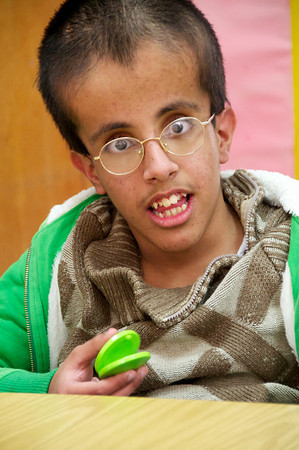
We were all excited that we found a castanet in the color of Salem's jacket! Salem speaks perfect Arabic and English and sings all the songs in tune. He is a great musical talent!

Wednesday, February 16, 2011

Music for Blind Children


On Sunday the 6th of February, we were invited to visit a new music project in the Yamaha Music School in Ramallah.
Together with MwB trainees Amira and Seereen, we took the long winding road from Bethlehem to Ramallah. Because Amira and Seereen are from al-Azzeh and Dheisheh refugee camps, they are not allowed to pass through Jerusalem, where the road is much faster and safer.
But taking the long road through Wadi Nar (Valley of Fire) has also positive sides. We had all the time to talk, enjoy the beautiful view of the desert and listen to music on the radio.


When we arrived in the Yamaha Music School, we felt immediately welcomed. The warm colors and soft carpet made us forget the cold weather outside. The director, Mirna Malouf, a woman with unending energy, hosted us for more than two hours. She is the brain and the motor behind this wonderful project.


Since October last year, 30 visually impaired and blind children from all over Palestine receive music education twice a week. Buses bring them from their homes to the music school where they learn to play the oud, percussion, accordion, (electrical) piano, or violin and sing in a choir. Two of the music teachers are blind themselves. The children receive the lessons in groups, which gives them support and improves their social skills.


But it doesn't end here....the children also receive lessons in solfege: reading and singing music notes.
They learn how to read and write the music notes in braille. Mirna showed us a braille music book and while I let my fingers go over the pages, I felt very small. How could one ever understand these dots? Some of my music students are having problems reading music, how can these blind children read music in braille?

The Yamaha Music School also offers music lessons for children that have normal vision. This makes the project even more beautiful, because the children learn to respect and support each other.


We were all very impressed and happy that such an important project exist. All the respect for Mirna and the music teachers!

The coming months, we will go back once a month to give music workshops for both the blind children and the children with normal vision. The challenge will be to find activities that will be fitting for all children, in which they can cooperate, be creative and use their many talents.


If you want to have more information about this wonderful project, please contact Mirna Malouf directly: mirnanagham@yahoo.com